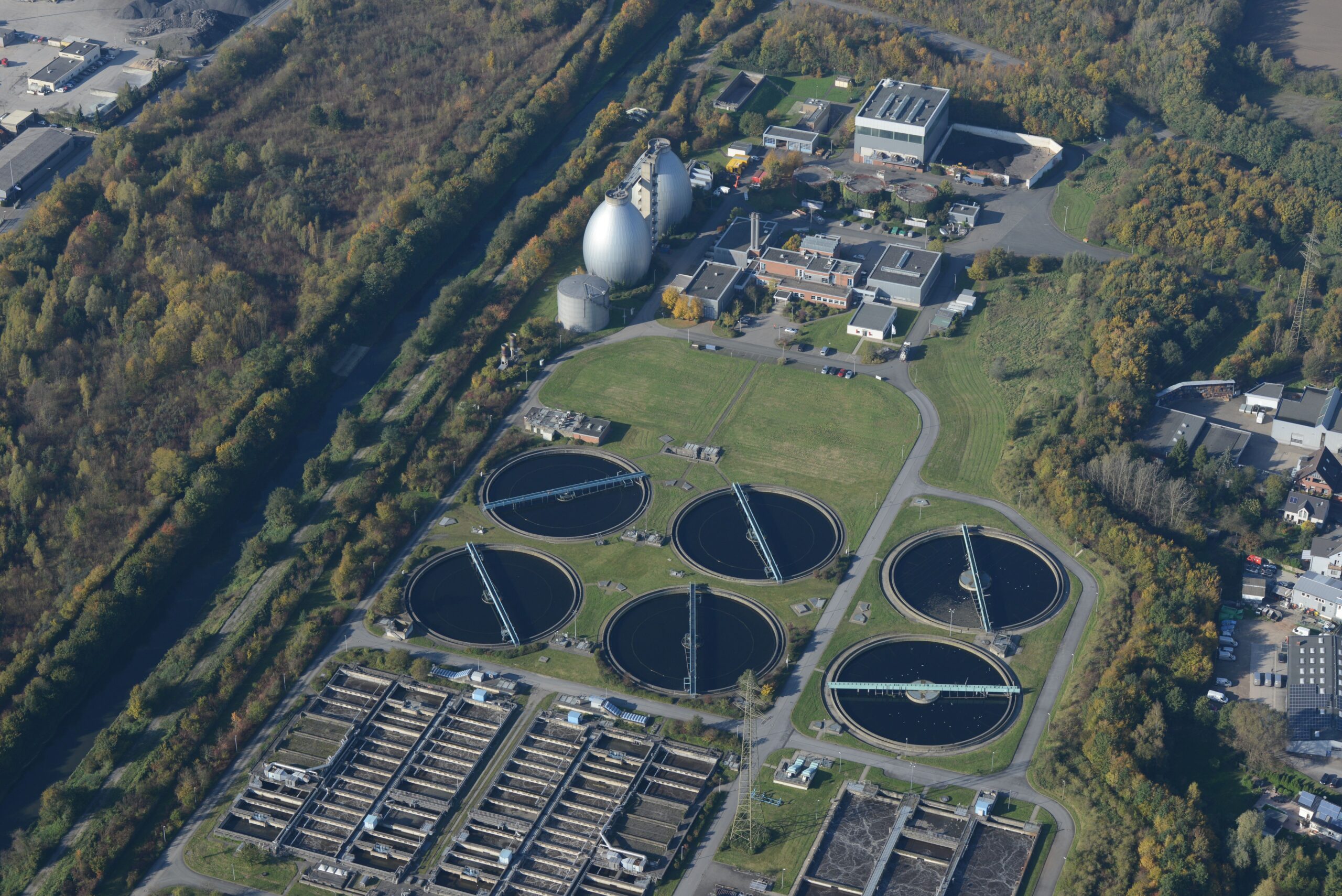
Ask what the Netherlands is famous for and water will be near the top of the list. The picture is a familiar one: a low country reclaimed from the sea, roughly a third of it lying below sea level and around two-thirds at risk of flooding, kept safe by a centuries-old tradition of dykes, sluices and purpose-built storm-surge barriers. That is the Netherlands the world knows — the country that keeps the water out.
What that reputation obscures is the other half of what it means to live in a delta. The same low geography that sits the Netherlands behind its sea walls also places it at the very end of the line of the rivers that drain half a continent. The Rhine and the Meuse reach the North Sea through Dutch territory, and they arrive carrying whatever the countries upstream have dissolved, discharged or flushed into them. Keeping the sea out is only one of the country’s water problems; the harder and far less visible one is coping with the water that comes from behind. It is that second problem, not the reclaimed-land one, that has quietly made the Netherlands one of the best places in the world at treating water.
That is the argument of this note. A country compelled by geography to clean water that others have already fouled builds, over generations, a deep and exportable competence in doing exactly that — and that hard-won excellence, now confronted by a class of pollutant its treatment systems were never built to remove, is exactly where a patient investor should be looking. PFAS, the forever chemicals now surfacing in Dutch eggs, breast milk and drinking water, are the centre of the story. But to see why they matter so much here, you have to begin with the water that arrives.
Forced to excel
The instinct that built the dykes did not stop at the coastline. The same discipline that keeps the sea out now governs the water the country actually wants to use — and here the geography works against it. Dutch utilities draw their supply from rivers that rise in other countries — the Rhine in the Swiss Alps, the Meuse in northern France — and by the time those rivers reach the border they have already been abstracted, used and returned as treated wastewater by the cities and industries of three or four nations upstream. The Rhine supplies drinking water to roughly thirty million people along its length before it ever reaches a Dutch tap. A Dutch water company has always had to make clean drinking water from a river that much of a continent has already used, flushed and used again multiple times.
Necessity made the country exceptionally good at this. The Netherlands is one of the very few places that delivers drinking water to the tap with no residual chlorine, relying instead on a layered “multiple-barrier” approach — riverbank and dune filtration, activated carbon, advanced oxidation and membrane steps — that strips contaminants out through successive natural and engineered stages. Around that practice has grown a dense innovation ecosystem: the Wetsus centre of excellence and the WaterCampus at Leeuwarden, the KWR water-research institute, the Netherlands Water Partnership and the Rotterdam-based Global Center on Adaptation, alongside utilities and engineering firms that now export Dutch water expertise worldwide. Water treatment is not a niche in the Netherlands. It is a national core competence, forged by the plain fact of being downstream.
The water that arrives
What that multiple-barrier system must contend with is a chemical cocktail that grows more complex every year, and the river-water companies that monitor the Rhine and Meuse — grouped as RIWA — record it in unsparing detail. In a recent assessment more than sixty substances exceeded target values in the Rhine alone. Among them were twenty-five different pharmaceutical residues — from X-ray and MRI contrast agents to painkillers and blood-pressure drugs — and fourteen industrial chemicals, one of them a tyre-manufacturing compound, HMMM, rising at around eighty percent a year since 2018. Nutrients, chloride and pesticides add to the load. Most of these the Dutch barriers can still manage, precisely because the system was built for this kind of assault. The worry is not the cocktail the Netherlands knows how to treat. It is the one ingredient it is currently struggling with.
PFAS is that ingredient, and it is why the forever chemicals now dominate every conversation about Dutch water. Unlike a painkiller or a contrast agent, PFAS does not break down, and the smaller compounds slip through conventional treatment largely untouched. In a 2024 study for the Dutch inspectorate, PFOS — one of the most studied of the family — was measured at every Rhine and Meuse intake used for drinking water at roughly five times the European environmental-quality standard; toxicity-weighted PFAS levels ran four to seven times above the health limit advised by RIVM, the national public-health institute. Ultrashort-chain TFA, a PFAS breakdown product from pesticides and refrigerant gases, exceeded a thousand nanograms per litre in the Rhine and passes through drinking-water treatment almost entirely unremoved. The inspectorate was blunt about the direction of travel: significant PFAS loads, measured in tonnes per year, are carried into the Netherlands from abroad by the rivers, with limits already breached at the borders with Germany and Belgium. For some Dutch consumers, drinking water alone now supplies between half and three-quarters of the maximum PFAS intake considered safe over a whole year.
From the river to the kitchen table
The consequences have stopped being abstract. In April 2025 RIVM advised the entire country to stop eating eggs from backyard chickens: at thirty-one of sixty locations tested, a person eating fewer than one home-produced egg a week would already exceed the health-based safety limit for PFAS, with earthworms the likely route carrying the chemicals from soil into the hen. Fifteen months later, in July 2026, the institute reported that every one of 1,629 samples of Dutch women’s breast milk contained PFAS, and that in eighteen percent of them the levels were high enough to risk effects on the developing immune systems of nursing infants — while stressing, correctly, that the benefits of breastfeeding still outweigh the risk. Eggs, milk, blood, tap water: the forever chemicals have moved out of the river and into the body, and onto the front pages. For a country that prides itself on the cleanest of drinking water, that is not merely a health story. It is a challenge to a national competence.
A problem the Netherlands cannot solve at its border
Here is the bind at the centre of this piece. The very thing the Netherlands does best — treating water — cannot by itself defeat a pollutant that arrives faster than it can be removed and never breaks down once captured. And the country cannot regulate its way out either, because the pollution is very largely not its own. The Chemours plant at Dordrecht, the legacy of 3M at Zwijndrecht just over the Belgian border, and the Indaver waste facility near Antwerp — which has discharged PFAS into water flowing toward the Dutch Westerschelde for years — sit close together but under different national rulebooks. Europe harmonises the chemicals themselves through REACH, yet leaves water permitting, waste handling and enforcement substantially to national governments, so discharges drift toward whichever jurisdiction is most permissive. TFA, meanwhile, forms from pesticides and gases used right across the continent. You cannot fence off a watershed. A downstream nation is the first to receive a new contaminant and the last able to stop it at source — so it must out-treat what it cannot prevent. That single sentence is an investment thesis in itself.
Regulation converges on the problem
The rules are now catching up with the chemistry, and they point demand squarely at treatment. The recast EU Drinking Water Directive already sets a binding limit of 0.1 micrograms per litre for the sum of twenty PFAS compounds, with mandatory monitoring live since the start of 2026. The larger measure is the universal PFAS restriction under REACH, proposed in 2023 by five member states including the Netherlands and Germany: the European Chemicals Agency’s scientific committees published draft opinions in March 2026 and opened a final consultation to late May, with a Commission decision expected around the third quarter of 2027 and any restriction taking effect from 2029 at the earliest. Pressure is building on TFA too, with civil-society groups and members of the European Parliament pressing for it to be regulated and for PFAS pesticides to be phased out. None of this removes a single molecule from the Rhine on its own. What it does is turn a diffuse public-health worry into mandated, funded demand for the technologies that can — and the Netherlands, already at the limit of what its barriers can strip out, will be among the first markets to spend.
What this means for how Aquius invests
The market context is straightforward. The global market for PFAS remediation — capture and destruction — was worth roughly USD 3.5 billion in 2024 and is projected to reach USD 8.2 billion by 2033, with Europe accounting for close to a third. Within that, the removal layer is the proven, soon-to-be-funded core: granular activated carbon, ion exchange and reverse osmosis are all at full commercial readiness and will absorb the first wave of mandated spending. These are the technologies the Dutch multiple-barrier system already knows how to deploy, and they are where near-term, low-risk demand sits.
But capture is not the same as cure, and that is where the real opportunity lies. Removal concentrates PFAS into spent carbon and reject brine that still has to go somewhere; destruction — from thermal incineration, the only method proven at scale, to the pilot-stage contenders of supercritical water oxidation, electrochemical oxidation and hydrothermal alkaline treatment — is the unsolved frontier. And none of the conventional methods deal well with the ultrashort-chain compounds, TFA above all, that are rising fastest in the rivers. The technology gap and the regulatory gap point in the same direction, toward genuine elimination rather than relocation of the problem.
Our thesis follows from the geography. A country forced to out-treat what it cannot prevent becomes the natural proving ground for the technologies the rest of Europe will shortly need, as upstream nations meet the same directives a few years behind. We therefore favour the proven removal layer for funded near-term demand, while concentrating our search for asymmetric returns at the destruction frontier, where sound intellectual property can be acquired before its moment fully arrives. We treat the Dutch water sector — its utilities, its research institutes, its engineering firms — as both a market and a source of deal flow. We watch the cross-border loads and the rise of TFA as leading indicators of where mandated demand breaks next. And, as ever in water, we underwrite to a trade sale into one of the strategics who consolidate the sector, not the flotation of a standalone champion.
The Netherlands did not choose to be downstream of a continent’s chemistry. It chose to become extraordinarily good at cleaning up the result. PFAS is the hardest problem that competence has yet faced — a pollutant that does not break down, already arrives from beyond the border, and has reached the breast milk of the nation’s mothers. Precisely because it is so hard, and so unavoidable, it is where the next decade of water innovation, and the returns that come with it, will be made. For capital that understands the map — and the simple fact that some countries are downstream of everyone else — that is not a burden. It is the edge.
About this piece
PFAS market, technology-maturity and cost figures draw on the Net Zero Insights “PFAS Market Snapshot” (21 August 2025). River and drinking-water figures are from the Dutch Human Environment and Transport Inspectorate’s 2024 study of PFAS in the Rhine, Meuse and drinking water, with wider water-quality data from RIWA and the International Commission for the Protection of the Rhine. The egg and breast-milk findings are from RIVM (2025 and 2026). Material on the Dutch water sector draws on the Netherlands Foreign Investment Agency and associated institutions (Wetsus, KWR). Regulatory detail is drawn from the cited EU directives and ECHA materials; the TFA discussion from PAN Europe and European Parliament sources. The interpretation and investment views are those of Aquius Capital.
References
- NetZero Insights. PFAS Market Snapshot, 21 August 2025 (market size, technology maturity and destruction data; remediation market ~USD 3.5bn in 2024 to ~USD 8.2bn by 2033).
- Ling AL. Estimated scale of costs to remove PFAS from the environment at current emission rates. Science of the Total Environment, 2024;918:170647.
- HumanEnvironment and Transport Inspectorate (ILT). Poly- en perfluoralkylstoffen (PFAS) in Rijn-, Maas- en drinkwater, 2024 (PFOS ~5× the EU standard; toxicity-weighted PFAS 4–7× the RIVM limit; TFA >1,000 ng/L).
- RIVM. RIVM advises against eating home-produced eggs (PFAS), 15 April 2025.
- RIVM. PFAS in Dutch women’s breast milk, 1 July 2026 (all 1,629 samples contained PFAS; 18% above the risk limit).
- RIWA-Rijn.Water quality of the Rhine falls short of targets (annual report) (60+ substances over target; 25 pharmaceutical residues; 14 industrial chemicals incl. HMMM +80%/yr).
- RIWA-Maas.Jaarrapport 2024 — De Maas (annual water-quality report on the Meuse).
- InternationalCommission for the Protection of the Rhine (ICPR/IKSR). Drinking water from the Rhine (≈ 30 million people supplied).
- NetherlandsForeign Investment Agency. Water Technology in the Netherlands (Wetsus, WaterCampus Leeuwarden, KWR, Netherlands Water Partnership, Global Center on Adaptation).
- European Directive (EU) 2020/2184 (recast Drinking Water Directive) — PFAS limit 0.1 µg/L for the sum of 20; monitoring from January 2026.
- European Chemicals Agency. PFAS restriction under REACH — committee draft opinions and 2026 consultation (draft opinions March 2026; Commission decision expected Q3 2027; entry into force from 2029).
- PAN TFA: The Forever Chemical in the Water We Drink (2024); European Parliament question E-001786/2025 on TFA and PFAS pesticides.
- Follow the Money. Nederland betaalt honderden miljoenen om pfas-afval naar België en Duitsland te sturen (cross-border PFAS waste flows).
- Belga News Agency. Major concerns in the Netherlands about PFAS pollution from Belgian source (Indaver, Antwerp).